In This Article
Hey, plant lovers! If you’ve ever walked through a greenhouse and seen something that looks like it came straight out of a gothic fairy tale, you probably met the Black Bat Flower. For more than 15 years, I’ve loved this strange tropical gem with its creepy but beautiful blooms that look like a bat in flight. I’ve been playing with exotic plants in my home and greenhouse setups. The first time I brought one home, it felt like adopting a little piece of the rainforest. It had those dramatic dark petals and whiskery filaments that set it apart from other pothos or fiddle leaf figs. The Black Bat Flower is more than just a plant; it’s a conversation starter, a collector’s prize, and proof that nature loves to surprise us with its crazy designs. This guide will show you everything I’ve learned from trial and error to help your Black Bat Flower thrive and bloom its heart out, whether you’re a beginner just getting started with rare houseplants or an experienced grower like me looking for the next thrill.
To kick things off, here’s a quick snapshot of the Black Bat Flower’s key details in a handy table. I’ve pulled this together based on my own experiences growing them alongside notes from years of observing how they behave in different setups.
Botanical Name | Tacca chantrieri |
Common Name | Black Bat Flower, Bat Plant, Tiger Beard, Cat’s Whiskers |
Plant Type | Tropical perennial herb |
Mature Height & Spread | 2-3 feet tall, 1-2 feet wide |
Bloom Appearance | Deep purple-black flowers with bat-wing-like bracts and long, whisker-like filaments |
Light Requirement | Bright indirect light or dappled shade |
Soil Type | Rich, well-draining mix with organic matter |
Water Needs | Consistently moist but not waterlogged |
Humidity Requirement | High (60-80% or more) |
Maintenance Level | Moderate to high |
What is the Black Bat Flower?

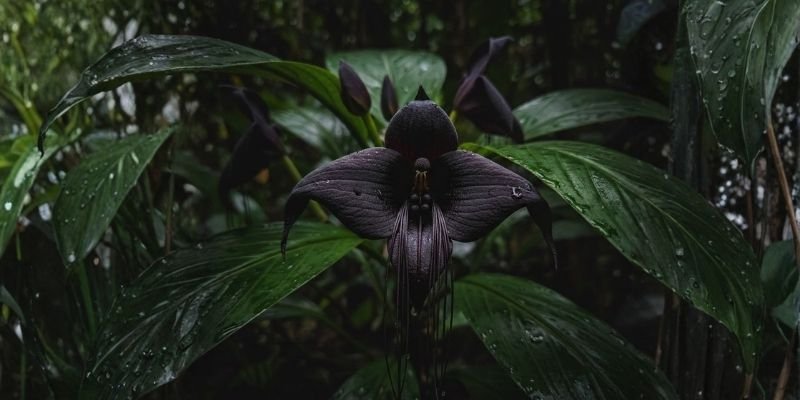
The Black Bat Flower is a real oddball in the plant world. It grows wild in the hot, humid tropical forests of Southeast Asia, like Thailand, Malaysia, and parts of China, where it grows under the thick canopy. The Black Bat Flower grows best as an understory plant in the rainforest, where it gets lots of filtered light and high humidity. The flowers of the Black Bat Flower are what make it so memorable. They’re not your usual pretty petals. Instead, you get these big, dark purple bracts that spread out like bat wings. They also have long, thread-like “whiskers” that can hang down a foot. I have seen them up close in my greenhouse, and they really do make me feel like I’m in a fantasy book. The Black Bat Flower is a member of the Taccaceae family. It has an exotic look, but it isn’t a real orchid. Over the years, I’ve seen how the plant’s rhizomatous roots help it spread slowly, making clumps that can grow many flower stalks in a good season.
Why Should You Grow a Black Bat Flower at Home?
If you like plants that are different and get a lot of attention, growing a Black Bat Flower is worth it. But it’s not for everyone. First of all, the Black Bat Flower is a must-have for collectors because it is so rare. I’ve traded cuttings with other fans who treat it like a trophy. The Black Bat Flower is a great way to make your home look more interesting, whether it’s sitting in a damp corner of your living room or stealing the show in a terrarium. The Black Bat Flower not only looks good, but it also has a subtle air-purifying effect. It pulls in moisture and filters the air in stuffy spaces. I’ve liked this during long winters when my house feels dry. Taking care of such an unusual plant is also good for your health; seeing those strange flowers open up after months of care feels like a personal victory. The Black Bat Flower adds an element of surprise and interest to your home, making it feel like a mini botanical garden if you’re tired of regular houseplants.
Seasonal Care Calendar
Caring for the Black Bat Flower shifts with the seasons, just like many tropicals I’ve grown over the years. I’ve put together this calendar based on how my own Black Bat Flowers have responded in my Delhi greenhouse—spring and summer are all about growth, while fall and winter call for a more hands-off approach to avoid stressing the plant.
Season | Key Tasks |
Spring | Repot if needed, start fertilizing every two weeks, increase watering as growth resumes, check for pests after dormancy, provide more humidity with misting. |
Summer | Maintain consistent moisture, fertilize regularly, ensure bright indirect light, prune any dead leaves, encourage blooms by keeping humidity high. |
Fall | Reduce fertilizing to once a month, ease up on watering as growth slows, move indoors if outdoors, monitor for dry air issues. |
Winter | Minimal watering (let top soil dry slightly), no fertilizer, keep in warm spot above 65°F, boost humidity with pebble trays, allow partial dormancy if leaves yellow. |
How to grow and take care of a black bat flower
It may seem scary at first to plant and care for your Black Bat Flower, but once you get the hang of the basics, it’s all about keeping an eye on it. I’ve lost a few over the years because of rookie mistakes, but each one taught me something useful. Let’s go through it step by step, starting with how to find the best place and how to keep it blooming year after year.
Step 1: Pick the right place for your indoor or greenhouse
The first thing to think about when you’re ready to bring home a Black Bat Flower is where it will live. From what I’ve seen, the Black Bat Flower does best in a warm, humid, and sheltered spot that looks like where it comes from in the tropics. I’ve had a lot of success putting mine in a bathroom or kitchen where steam from showers or cooking naturally raises the humidity. If you have a greenhouse like I do, try to find a corner that is out of the wind and in the shade. The Black Bat Flower likes temperatures between 70 and 85 degrees Fahrenheit during the day and no lower than 65 degrees Fahrenheit at night. If it gets any cooler, it might get sad or lose leaves. Stay away from places near air conditioners or heaters, because sudden changes can shock the plant. I’ve learned that putting the Black Bat Flower with other plants that like humidity makes a little microclimate that keeps everyone happy.
Step 2: Give Bright Indirect Light
The Black Bat Flower needs light, but it has to be just right. If you give it too much light, the leaves will burn; if you don’t give it enough, the flowers might never bloom. Based on my experiences, bright indirect light works wonders, like the dappled shade that comes through a sheer curtain or near a window that faces east. I use shade cloth in my greenhouse to block out the harsh midday sun. This keeps the Black Bat Flower’s leaves from getting crispy. If you are growing the Black Bat Flower inside, turn it every few weeks to make sure it grows evenly. I’ve seen that the plant might go semi-dormant in the winter when there’s less light, but in the spring, when the light increases, the flowers start to bloom. The Black Bat Flower can’t handle direct sunlight; it can turn yellow or brown faster than you can say “bat wings.”
Step 3: Make a tropical soil mix that is rich and drains well.
Your Black Bat Flower’s soil needs to be just right: it needs to be rich in nutrients but drain quickly, or the roots will rot. Over the years, I’ve tried different mixes and found one that works best for me. It has about 50% peat moss to hold moisture, 30% pine bark to let air in, and 20% perlite or sand to keep things loose. This mix is like the natural, forest-floor soil where the Black Bat Flower grows. I always add a handful of compost to the pot before planting to give the plants more nutrients. Check that the pH is a little acidic, between 5.5 and 6.5. I used simple strips to check mine. A wide, shallow pot is best for the Black Bat Flower because it lets the rhizomes spread without sitting in water. This has saved me from many soggy disasters.
Step 4: Putting the Black Bat Flower in the ground or in a new pot
If you take care of the rhizomes, which are the plant’s heart, planting or repotting the Black Bat Flower is easy. Fill the pot you chose with the soil mix, but leave room for the rhizome to sit just below the surface. I have always planted my Black Bat Flower rhizomes on their sides, lightly covering them with soil and watering them well to settle everything. When you repot a Black Bat Flower that has been growing for a while, do it in the spring when new growth starts to show. Gently pull the roots apart and get rid of any mushy parts. Put the pot in its place after planting and mist the leaves to help them get used to their new home. Every two to three years, when the Black Bat Flower outgrows its pot, I repot it in my greenhouse. Each time, it comes back stronger.
Step 5: Watering Without Giving Too Much Water
It’s like dancing to water the Black Bat Flower. The soil should be damp but not soggy, like a sponge that has been wrung out. In the summer, I water mine every 5 to 7 days. I check the top inch of soil first; if it’s dry, it’s time. Always pour from the base to keep the leaves dry, and use water that is at room temperature to avoid shocking the roots. In the winter, I cut back every 10 to 14 days because the Black Bat Flower slows down. One thing I’ve learned is to use a saucer to catch extra, but empty it after 30 minutes so it doesn’t rot. If the leaves of the Black Bat Flower are wilting, it may not be getting enough water. However, if they are turning yellow, it may be getting too much. You should change the amount of water based on the conditions in your home.
Step 6: Keeping the humidity level high
The Black Bat Flower needs a lot of humidity. If it doesn’t get it, the edges turn brown and growth stops. Try to get the humidity level between 60 and 80%. I did this by putting pebble trays filled with water under pots; the water evaporates and does the job. During the drier months, I mist my Black Bat Flower every day with a fine mist or run a humidifier close by. Putting plants together also helps because they make their own humid bubble. If your area is dry, you might want to get a terrarium for the Black Bat Flower. Mine did well in one during a dry spell. To keep your Black Bat Flower healthy, look for signs like crispy tips and slowly raise the humidity.
Step 7: During active growth, feed and fertilize.
During the active growth period from spring to fall, fertilizing the Black Bat Flower makes those big blooms happen. Every two weeks, I use a balanced, water-soluble fertilizer like 10-20-10 that has been cut in half. This gives flowers the extra phosphorus they need without hurting the plant. From what I’ve seen, orchid fertilizers work well too because they meet the Black Bat Flower’s needs. Don’t feed the Black Bat Flower in the winter when it rests, or else salt will build up. To keep things clean, always fertilize after watering and flush the soil with plain water once a month.
Step 8: Taking care of pests, diseases, and problems with leaves
Pests and diseases can sneak up on the Black Bat Flower, but if you act quickly, you can keep them away. When the air is dry, spider mites can get on the leaves and make webs. To get rid of them, I spray them off and add more moisture. Mealybugs are another enemy; use a cotton swab dipped in alcohol to kill them. Root rot from too much water is a common problem that makes stems mushy. If you see it, repot the plant in new soil and cut off the affected roots. If your leaves are turning yellow, it could be because they aren’t getting enough nutrients. Check your fertilizing schedule. Check your Black Bat Flower often and use neem oil every few months to keep it safe.

Step 9: Taking care of the Black Bat Flower for a long time and getting it to bloom
The Black Bat Flower needs time to grow and bloom. It might take a year or two for the flowers to show up. Cut off dead flowers to redirect energy, and every few years, separate clumps that are too big. To get those bat-like flowers to grow, keep up with their care by giving them the right light, humidity, and food. When they’re happy, mature Black Bat Flowers in my greenhouse make a lot of stalks every season. Don’t worry if it goes dormant in the winter. Just cut back on care and wait for it to come back to life in the spring. Over time, your Black Bat Flower will become a strong plant that will reward you with its otherworldly beauty.
Problems and Solutions That Happen a Lot
Problems can still happen with the Black Bat Flower, even if you mean well. If the leaves are yellow, it could mean that the plant is getting too much water or that the drainage isn’t good. I fix this by letting the soil dry out more between waterings and making sure the pot has holes. If your Black Bat Flower isn’t blooming, it might not be getting enough light or humidity. Move it to a brighter place and add a humidifier. When the soil is too wet, root rot can sneak in and cause plants to wilt even when they are getting enough water. You can save them by repotting them and cutting away the rot. Brown tips are caused by dry air. You can stop this by misting your plants every day or putting them on pebble trays. Aphids and other pests may show up, but a gentle soap spray usually gets rid of them without using chemicals.
Things Beginners Shouldn't Do
I see the same mistakes with the Black Bat Flower that I’ve seen with many new growers. The most important thing is to not put it in direct sunlight, which can burn the leaves. Always choose indirect light. Another killer is low humidity. Don’t skip misting just because the edges are crispy. Heavy soils don’t drain well, which can cause problems with roots. Use well-draining mixes instead. Overfertilizing can burn roots, especially in the winter. Stick to the growing seasons. Finally, if the temperature drops below 65°F, the Black Bat Flower could go into shock. Keep it warm all year.
Ideas for how to style and display things indoors
The Black Bat Flower’s dramatic look makes it great for creative displays. I put mine on a plant stand in a bathroom with a lot of moisture. The steam makes it feel better, and the dark flowers stand out against the white tiles. Put the Black Bat Flower in the living room with macramé hangers near a window so that the flowers can hang freely. Put it with ferns and orchids in a greenhouse or sunroom to make a tropical corner. Use black or metallic pots with decorations to match its gothic style. A terrarium is a great way to show off the Black Bat Flower as a focal point while keeping the humidity high in a small space.
Tips from the pros for bigger flowers and better growth
After years of practice, these are my best tips for the Black Bat Flower. Use rainwater to water your plants instead of tap water, which can cause minerals to build up. In the spring, add some banana peel tea to your flowers to give them more potassium. To keep fungi from getting into the plant, make sure there is good air flow around it. A small fan on low helps. If the leaves are drooping, look for crowded roots and repot. Water the bottom of the plant every now and then to help it grow deeper roots. And patience is important; the Black Bat Flower blooms best when you don’t bother it too much.
Ways to Spread (Division + Rhizomes)
It’s easy and rewarding to grow the Black Bat Flower by dividing it or using rhizomes. In the spring, carefully lift the plant and cut the rhizomes apart with a clean knife. Make sure that each piece has roots and a growth point. Put them in new soil mix, water them lightly, and keep them in a humid place until they grow. This has worked for me 80% of the time. For rhizomes, cut healthy pieces and let them callus for a day. Then, plant them in shallow pots with moist soil and cover them with plastic to keep them humid. Sprouts will come up in 4 to 6 weeks. Mist them often. Seeds are harder, but they can be done. Plant fresh seeds in seed trays that are warm and moist, but it can take months for them to sprout.
The Black Bat Flower needs a little more care than most houseplants because it needs humidity, careful watering, and the right light. But after a long time of growing them, I can say that it’s totally worth it—the thrill of seeing those creepy flowers bloom is like nothing else. Your Black Bat Flower will give you years of beautiful flowers if you give it the tropical love it needs.
FAQs
1. What is it about the Black Bat Flower that makes it hard for beginners?
The Black Bat Flower can be hard to grow because it needs certain conditions that aren’t always easy to recreate indoors, like high humidity and warmth that don’t change. From what I’ve seen, a lot of new growers don’t realize how sensitive it is to dry air, which causes problems with the leaves early on. Start with a small humidifier and keep a close eye on it. Once you get the environment just right, the Black Bat Flower will be more forgiving and can even adapt to small changes.
2. How long does it take for a Black Bat Flower to bloom after you plant it?
The Black Bat Flower usually takes 1 to 2 years to go from a rhizome to its first bloom, depending on how well it is cared for. In the best greenhouse conditions, mine has bloomed sooner, but it could take up to 18 months indoors. First, make sure the roots are strong by giving them enough water and light. Adding too much fertilizer too quickly can make things worse.
3. Is it possible to grow the Black Bat Flower outside all year?Yes, but only in shaded, humid areas in tropical climates like zones 10–12. I have tried it in milder areas, but frost is deadly. If the temperature drops below 60°F, bring the Black Bat Flower inside. Keep the soil moist by mulching and keeping pests and wind away from the plants.
4. How can I tell if my Black Bat Flower is getting too much light?
Browning or burned edges on the leaves are classic signs of the Black Bat Flower. If the flowers fade quickly or the leaves curl, cut back on the light. I’ve saved plants that were getting too much light by moving them to a place with filtered light, where they get extra humidity to help them get better.
5. How can I make the air more humid for my Black Bat Flower without using a humidifier?
Fill a tray with stones and water, then put the pot on top. Pebble trays are great. It also helps to group with other plants or mist them twice a day. A simple bathroom placement during showers naturally increases moisture for the Black Bat Flower in my setups.
6. Is the Black Bat Flower bad for pets?
The Black Bat Flower isn’t very poisonous, but it can make cats and dogs sick if they eat it. I’ve kept mine out of reach in homes with pets, and there have been no problems. But you should always watch out for curious animals around exotic plants.
7. What kind of fertilizer works best to get Black Bat Flowers to bloom?
A phosphorus-rich formula, like one for orchids, works when it is diluted once a month during the growing season. I now use organic options like fish emulsion on my Black Bat Flower. This helps the flowers grow strong without adding chemicals.
8. How often do I need to put my Black Bat Flower in a new pot?When the roots get too big for the pot, or every two or three years. Spring is the best time; gently separate if you need to. Repotting the Black Bat Flower is part of my routine that refreshes the soil and helps it grow better.